
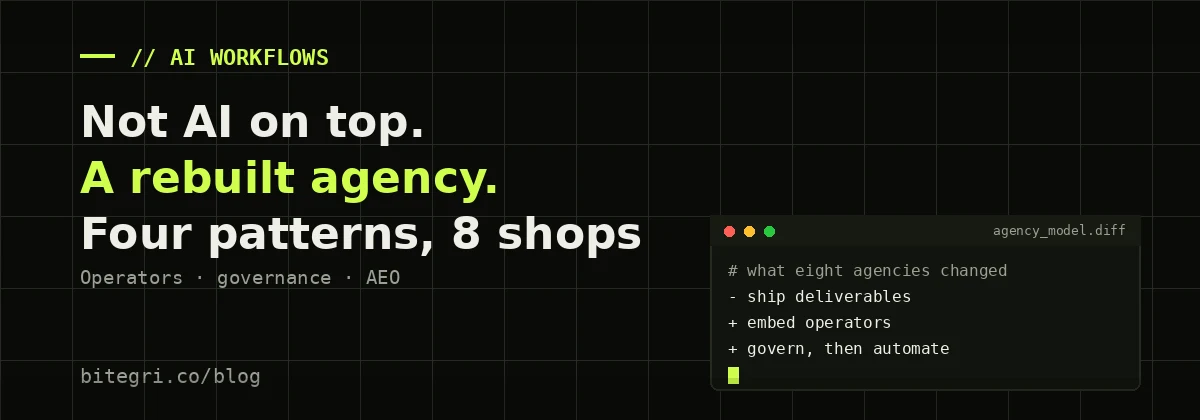
The agency model is being rewritten in real time
The Marketing AI Institute put it plainly in a recent piece by Cathy McPhillips: the agency model is being rewritten in real time, and a growing gap is emerging between the shops embracing AI and those sticking with the status quo. We see it too. The most interesting agencies aren't bolting AI onto their existing service menu. They're rethinking what an agency is for.
The Institute profiled eight agencies (all MAICON 2026 sponsors, to be clear about where the examples come from) that are doing exactly that. Read together, they form a useful map of where the work is going. Below we pull out the patterns we think matter most for anyone running or buying agency services right now.
Pattern one: embedding operators, not shipping deliverables
Several of the featured agencies have stopped behaving like traditional vendors. Algomarketing deploys senior practitioners inside existing teams to study workflows first, then co-builds AI-native agents that automate the tasks they find. EMMIE Collective embeds experienced marketing and revenue operators directly into client teams, providing on-demand support across platforms like Marketo, HubSpot, Salesforce and Tableau rather than functioning like a classic agency. Fjorge works behind the scenes as a development partner, often embedding with creative and marketing agencies to supply the technical muscle.
The common thread is proximity. You cannot automate a process you have never watched happen. When someone sits inside your team and learns how the work actually flows, the AI they build reflects reality instead of a slide deck. This mirrors something we have argued before about the difference between speeding up a broken process and rebuilding it, which we covered in our take on transforming workflows rather than just accelerating them.
Pattern two: consulting and governance move to the centre
The second pattern is that the strategy layer is getting heavier, not lighter. Demand Spring, a B2B revenue marketing consultancy, helps teams move beyond AI experimentation by developing strategies, automating workflows, training teams, and establishing the governance needed to operationalise AI at scale. Seer Interactive, in the space for 20+ years per the Institute's write-up, runs its own internal AI Lab and turned that hands-on experience into a custom AI consulting offering called SeerAdvance.
Governance is the word we keep circling. Experimentation is easy. Getting AI to run reliably across a whole team, with rules about what it touches and how its output is checked, is the hard part. That is consulting work, and it is where the durable value sits. Tools change every quarter. A team that knows how to evaluate and govern them does not.
Pattern three: AI-native delivery with humans on strategy
The third pattern is the most instructive. Intercept describes an AI-native delivery model: proprietary AI tools and workflows accelerate research, content production, personalisation, campaign execution and measurement, while strategy and creative stay human-led. Level Agency uses AI orchestration for brands with complex, high-consideration buying journeys, building repeatable, AI-powered systems that connect strategy, execution and data across the customer journey.
Notice what is automated and what is not. The repeatable, high-volume, evidence-heavy work gets systematised. The judgement calls stay with people. This is not a compromise; it is the correct division of labour. AI is very good at doing the same defensible thing a thousand times and terrible at deciding whether it should. Both Intercept and Level appear to draw the line in the same place, and we think they are right to.
Pattern four: chasing the new search surface
Soarion Digital is leaning hard into AI search, blending AI technology with human expertise to help clients become the go-to answer inside AI search tools. Their process starts with a new search foundation, builds citation-driven content, earns third-party validation, and grows AI referral traffic gradually through weekly updates. Seer and Level also list AI search or AEO among their capabilities.
This is worth taking seriously. The surface where buyers ask questions is shifting from ten blue links to a single synthesised answer. Being the source that answer cites is a different discipline from ranking, and the agencies naming it now are the ones building the muscle early. We would not treat it as a replacement for everything else yet, but ignoring it entirely is a bet against where attention is clearly moving.
What buyers should take from this
Strip away the individual names and a few practical questions fall out for anyone evaluating agencies, or evaluating their own shop.
First, does the partner build systems or ship deliverables? A campaign you receive is spent the moment it runs. A repeatable, AI-powered system keeps producing. The featured agencies overwhelmingly talk about systems, agents and workflows rather than one-off outputs.
Second, who owns the data and the instrumentation? None of these AI-native models work without clean, connected data underneath. An agent that reads from a warehouse is only as good as what is in the warehouse. This is unglamorous and it is the whole ballgame. If the measurement layer is a mess, the fanciest orchestration on top of it will confidently produce nonsense.
Third, where is the human line drawn? The best examples above are explicit that strategy and creative stay human-led. Be suspicious of anyone promising fully autonomous everything. The agencies actually shipping this work are careful about the boundary, and the security realities around what autonomous agents can and cannot safely touch reinforce why that caution is warranted, a theme we dug into when Claude's agent sandbox updates raised exactly this question for marketing leaders.
The gap is about posture, not tools
What separates these eight from a traditional shop is not a tool licence. It is posture. They study the work before automating it. They put the strategy and governance layer at the centre. They keep humans on judgement and hand the repeatable volume to systems. And they are already building for the search surface that is coming rather than defending the one that is fading.
None of that requires you to be an eight-person AI lab. It requires deciding what parts of your work are genuinely repeatable, getting your data clean enough to trust, and building systems on top instead of buying another subscription. The gap widens fastest for the people waiting for a perfect tool that will never arrive.
Talk to us
If the data-and-instrumentation layer under all of this is what is holding you back, that is precisely what we do. We build GA4, BigQuery, GTM and MCP pipelines so your analysis runs on data you can defend. Talk to Bitegrico about an MCP or analytics implementation and we will show you what a system that keeps working looks like in practice.