
Most marketing teams have quietly settled into the same relationship with AI: it drafts the email faster, spins up ten subject-line variations faster, scores the leads faster. Faster, faster, faster. And there's nothing wrong with faster on its own. But if that's the whole strategy, we've set a ceiling on what AI can do for us before we've even started.
The Marketing AI Institute recently published a preview of a MAICON 2026 session by Liza Adams of GrowthPath Partners, and it names the problem cleanly. Most teams, Adams argues, use AI to do old work faster, and that should be a starting point, not the goal. Doing things differently is where growth happens. We've come to the same conclusion from the implementation side of the table, so we want to unpack what "differently" actually looks like in a marketing workflow.
The test that separates faster work from reimagined work
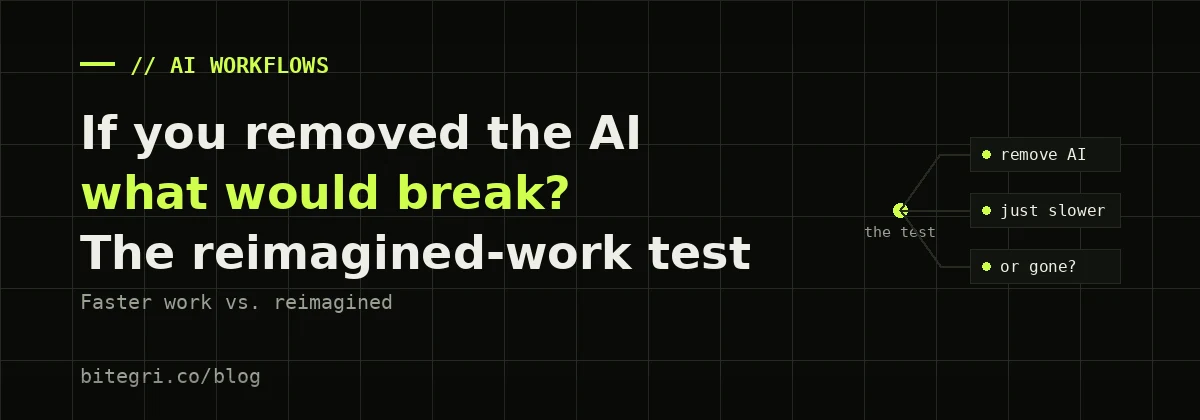
Adams offers a test that is worth stealing outright. Take AI out of the workflow and ask what happens. If the work would just take longer, that's faster work. If the work wouldn't happen at all, because it took too much time, cost too much, or wasn't practical before AI, that's reimagined work.
That single question reorganizes how you think about your entire stack. Auto-generating meta descriptions? Take the AI out and an intern does it slower. Faster work. But an agent that interviews your CMO on their commute, fact-checks what they said, and hands your writers a structured brief before lunch? Take the AI out and that interview simply never happens, because nobody had the calendar time. That's the line.
The reason this matters isn't philosophical. As the Marketing AI Institute preview puts it, an efficiency-only AI strategy quietly makes the case for fewer people, while reimagined work makes the case for why humans are essential. If everything you do with AI is compress existing tasks, you are building a spreadsheet argument for a smaller team. If you use AI to do work that was previously impossible, you are building an argument for a better one.
A concrete example: the AI expert interviewer
The best illustration of reimagined work we've seen recently comes from the SmarterX content team, described in a separate Marketing AI Institute post. Their bottleneck was one every content team knows: original insight is the scarce resource, and the only place it lives is inside busy subject matter experts who never have time to sit for an interview.
So they built an MVP of an AI agent that interviews experts inside ChatGPT. According to the post, it researches the assignment, topic, audience and what the expert has said in recent podcast episodes, running research tasks in parallel so it arrives prepared. It then interviews the expert one question at a time, letting each answer shape the follow-up, and at the end it produces a structured brief with main takeaways, pull quotes, a full transcript and source context, while fact-checking the claims the expert made along the way.
Notice what this is not. It is not a content generation tool. The post is explicit that the agent makes it easier for a busy expert to contribute their thinking, for instance by doing the interview during a walk or a morning commute rather than carving an hour out of the workday. The human insight is still the product. The AI removed the scheduling and access constraint that used to kill the whole idea before it started. That is the reimagined-work test passing in real life.
Multi-agent content factories are the same idea, scaled
Once you accept the test, the natural next question is: what other workflows only become possible when you chain agents together? This is where multi-agent setups earn their keep. A single agent that drafts a post faster is still faster work. But a pipeline where one agent harvests source material, another drafts against a brief, another checks claims, and another tracks what actually got published and how it performed, that pipeline does work no individual could sustain by hand across a real content calendar.
The unlock is not the drafting. It's the coordination and the memory. Agents can hold the full context of a topic, an audience and a brand voice across dozens of pieces at once, and they can do the unglamorous connective work, tagging, routing, verifying, that humans skip when they're busy. For marketing teams this changes what "in scope" means. Research that was too expensive to run for every post becomes standard. Fact-checking that used to be a nice-to-have becomes a built-in step.
Of course, giving agents this much reach raises real operational questions about what they're allowed to touch, which is exactly why we've written before about what marketing leaders need to know about agent security and sandboxing. Reimagined workflows and governance are two sides of the same build.
Why the connective layer matters more than the model
Here's the part most teams underestimate. The interesting reimagined workflows almost never depend on picking the smartest model. They depend on giving agents reliable, structured access to your actual data and tools. An interview agent is only useful if it can read past podcast transcripts. A content-tracking agent is only useful if it can see which posts shipped and what they did in analytics.
That access layer is where the Model Context Protocol has become the practical standard, letting agents reach into the systems where your marketing reality actually lives. We've made the case for why this is the direction of travel in our piece on how MCP turns SaaS into agent-accessible surfaces. The lesson from our own builds is blunt: the model is rarely the constraint. Clean, queryable data and well-scoped tool access are the constraint.
How to start, without reorganizing anything
Adams is direct about where leaders go wrong, and one point stands out: the work changes first, then roles, then the org chart. She frames reorganizing the team first as backwards, like hiring actors before you have a script. We'd add a practical corollary from doing this repeatedly. Don't start by buying licenses and calling it a strategy either. Start with one workflow that fails the reimagined-work test today, meaning it doesn't happen at all because it's too slow or too expensive, and ask what would make it possible.
The Marketing AI Institute preview also flags a quieter failure mode worth naming: leaders who say they want experimentation and then shut it down the first time it fails. Reimagined workflows are experiments. The interview agent above is described as an experiment in progress that the team is still measuring. If your culture punishes the first miss, you'll never get to the workflow that changes things.
So pick one. Find the piece of high-value work your team wants to do and never gets to. Interview the experts you never schedule. Run the research you always skip. Track the content you publish and forget. Then build the smallest agentic version of it you can, wire it to your real data, and keep a human at the gate. That's not faster work. That's work that wasn't possible before.
Talk to us
If you're trying to figure out which of your marketing workflows are worth reimagining, and how to wire agents safely into GA4, BigQuery, GTM and Google Ads so they can actually do the work, that's exactly what we build. Talk to Bitegrico about your MCP and analytics implementation, and let's find the workflow that only becomes possible once the plumbing is right.