
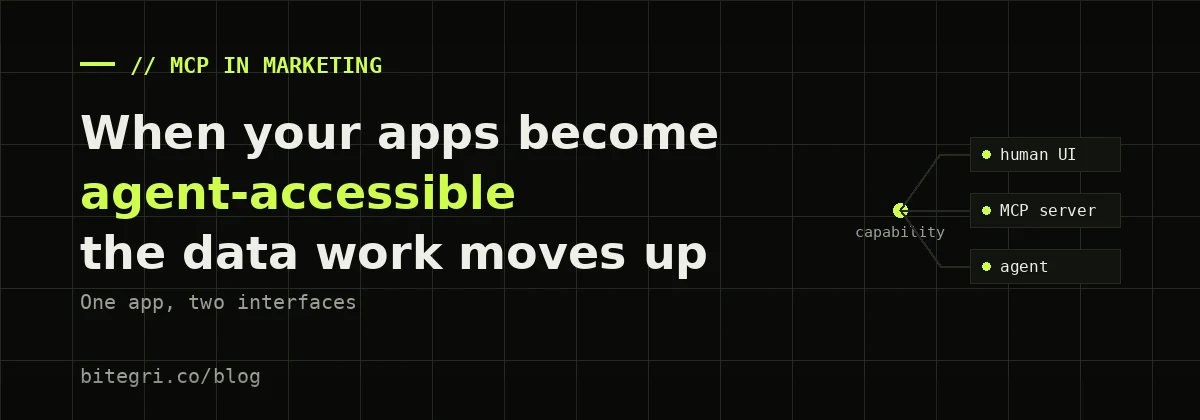
We spend a lot of our time wiring marketing tools together so they actually talk to each other. So when Lovable's CTO Fabian Hedin sat down with Latent Space to explain why the company is moving into MCP-powered "capabilities," we paid attention. It confirms something we have been building toward for a while: the interface for software is shifting from humans clicking around to agents calling functions directly.
What Lovable Is Actually Doing
Lovable is best known as an AI-powered platform to build applications. But according to Richard MacManus's interview for Latent Space, it is now moving toward a future where fewer people use conventional apps at all. The reason is agents.
Lovable defines a capability as a useful part of an application that an agent can call directly, without a human needing to open the app at all. The mechanism is a hosted MCP server: a published application exposes a chosen subset of its functions as tools, and the app ends up with two front doors rather than one. There is the traditional interface a person clicks through, and there is an agent interface reachable from ChatGPT, Claude and other MCP-compatible clients.
The phrase Lovable used for the broader vision, in a blog post of its own, was "a digital brain for your team connecting your daily tools." Hedin's framing in the interview was more concrete: "you can get to a place where you're using one entry point to all the work that you're doing."
That is the part worth sitting with. Not "build apps faster." One entry point to all the work.
Why This Matters For Your Marketing Stack
Most marketing stacks are a collection of UIs. Someone logs into Google Ads to check spend. Someone else opens GA4 to pull a report. A third person exports a CSV, pastes it into a sheet, and writes a summary that lands in a Slack channel nobody reads. Every one of those steps assumes a human sitting in front of a screen, doing the clicking.
The MCP capability model breaks that assumption. If your tools expose their useful functions as capabilities an agent can call, then the work of pulling, joining and interpreting data stops being a human chore. The agent does it. The human reviews the output and makes the decision.
We are not speculating about this. It is how we already work internally, and it is a large part of what we mean when we talk about analytics and MCP implementation.
What We Built, And What It Taught Us
The thing nobody tells you about this shift is that the model is the easy part. What makes an MCP setup useful is not that Claude can technically reach your tools. It is whether the data on the other side is clean, consistent and trustworthy enough for an agent to reason over without producing confident nonsense.
When we connect Claude to Google Ads, the value comes from the fact that BigQuery already holds structured, verified event data it can join against. If our BigQuery tables were a mess, the agent would happily give us a mess back, phrased with total authority. The capability is only as good as what sits behind it. We went through this in more detail in our guide to connecting AI agents to marketing data sources.
This is exactly the two-interface point from the Latent Space piece, seen from the buyer's side. A human UI forgives sloppy data because a person applies judgment and squints at the numbers. An agent interface does not squint. It takes the function at its word. So the discipline you need to expose a capability safely is much higher than the discipline you need to ship a dashboard.
The Real Work Moves Upstream
Here is the pattern we keep seeing. When tools become agent-accessible, the competitive question stops being "which tools do you use" and becomes "how well is your data plumbed together."
Everyone will have access to Claude and ChatGPT. Everyone will be able to point an agent at an MCP server. What differs is whether your Google Ads data, your event data in BigQuery, and your GTM configuration line up cleanly enough that an agent can move between them and produce something you would actually act on.
That is where the effort goes now. Not into learning a new UI. Into making sure the underlying data model is coherent enough to be queried by something that will not stop to ask a clarifying question.
What To Do About It
If you want your marketing stack ready for the agent-accessible world Lovable is describing, the practical steps are unglamorous and they all sit upstream of the AI.
First, get your measurement pipeline honest. If you cannot verify in your own warehouse that an event fired the way you think it did, an agent reading that data will inherit every quiet error you have been living with.
Second, standardise how your tools name and structure things. Agents chain functions together across systems. Inconsistent naming between platforms is friction a human works around instinctively and an agent trips over.
Third, decide what you actually want an agent to be able to do before you expose anything. Lovable's model is built on exposing selected functions. Selected is the operative word. The point is not to hand an agent the keys to everything. It is to expose the specific, well-defined capabilities that are safe and useful to call.
Fourth, treat the human review step as a permanent feature, not a training-wheels phase you will remove later. The two-interface model exists because both interfaces matter. The agent does the fetching and joining. The human still owns the decision.
Where This Goes
By Latent Space's account, Lovable went from an open source coding tool to a commercial product to an all-round software creation and hosting company, and on into agentic workflows, in under three years. That is a useful reminder of how quickly the ground moves in this space. The specific product matters less than the direction, and the direction is clear: software is being reshaped so agents can use it directly.
Hedin's own summary of the hard part is worth repeating, because it is the same lesson we keep relearning on the data side: "Orchestrating these capabilities is the easy part. Making sure they are well connected, built correctly and reliable is the hard part."
For marketing teams, the winners will not be the ones with the fanciest AI. They will be the ones whose data is clean enough, and whose integrations are tight enough, that an agent can do real work across the whole stack without a human babysitting every step.
That groundwork — the pipelines, the tagging, the warehouse, the MCP connections — is exactly what we build. If you want your marketing stack ready for agents that can actually use it, talk to us at Bitegrico about MCP and analytics implementation.