
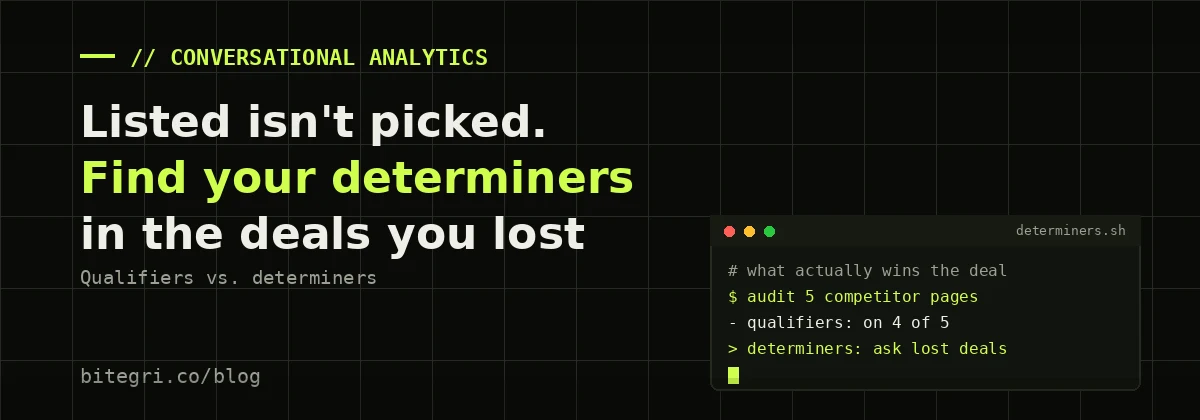
Ask ten B2B buyers what matters when they pick a vendor and you'll hear the same list every time: price, integrations, ease of use, good support, security. So marketers dutifully put that list on the homepage. The problem, as Peep Laja laid out in a recent LinkedIn post, is that every competitor asked the same question and got the same answer. Then everyone built the same homepage.
We see this constantly in the sites we instrument. A hero section that could belong to any of five competitors, a feature grid of claims that read as reassuring and interchangeable at the same time. The page feels safe. It also fails to move anyone from "on the list" to "this is the one."
Two kinds of buying criteria
Laja's framing is the cleanest version of this we've seen, so we'll use his language. There are two kinds of buying criteria.
Qualifiers are the things buyers need, but every vendor has. They get you onto the shortlist. They don't get you picked. SOC 2 is the classic example: don't have it and you're cut, have it and you're even with everyone else.
Determiners are the things buyers need and see real differences on. That's where deals actually get decided.
The test is two questions, not one. How important is this? And how different are the vendors on it? High on both means it's a determiner. Important but the same across the field means it's a qualifier: mention it and move on. Most teams only ask the first question. That's precisely why so many homepages look alike.
And here's the part that stings: you can't get the answer from your current customers alone. They already picked you. Their feedback mostly confirms that the qualifiers held. To find the determiners, you have to ask the people who didn't buy. Lost deals remember exactly why someone else won.
A faster first pass: audit the field before you interview anyone
Before you run a single interview, there's a quick way to flush out the qualifiers. Adam Hafez made this point in the comments on Laja's post, and it's a good one: list every claim on the homepages of your five closest competitors. Anything that shows up on four of the five cannot be a determiner, however important buyers say it is. What's left is the short list worth testing with people who didn't buy.
We like this because it's cheap and it's honest. It forces you to see your own messaging the way a buyer comparing five tabs sees it. If your headline is a claim four competitors also make, you are not differentiating. You are blending in while paying for the privilege.
Then survey the lost deals
The interview that matters is with buyers who evaluated you and chose someone else. The single most useful question is close to the one Sean Smith described in his own post on shortlist formation: who was on your list, and why did the winner win? You are listening for the criterion that tipped the decision, not the tidy list of requirements they'd recite to anyone.
Two refinements worth building in. First, sort the answers by segment before you touch the homepage, because a determiner for a twenty-person team can be a pure qualifier for enterprise. Second, re-run the exercise over time. A qualifier can flip into a determiner, and back again, as a category matures: once enough vendors catch up on something you used to own, it goes table stakes, and the thing you ignored last year might now be where deals turn. The homepage audit is not a one-time job.
Now prove it moves conversion, don't just assume it
Here is where most "messaging" projects quietly stall. A team runs the interviews, identifies a determiner, rewrites the hero, and declares victory. Nobody checks whether the new message actually changed behaviour on the page. This is the gap we care about most, because it's an analytics problem, not a copywriting one.
If you want to know whether a determiner-led homepage outperforms a qualifier-led one, you have to be able to attribute conversion events back to the message a visitor saw. That means event instrumentation that survives all the way into a warehouse you can query, not a vanity dashboard that reports sessions and bounce rate and nothing you can act on. We've written before about the difference between tooling that just speeds up existing work and tooling that changes what you can see at all, in how to use AI to transform marketing workflows rather than just speed them up. Messaging testing is the same shift: the point is not a faster A/B test, it's being able to ask a question you couldn't answer before.
What the measurement setup needs to support
To test determiners against qualifiers properly, your pipeline has to let you do three things. Segment conversion by the variant and the message a visitor was exposed to. Follow that visitor through to the events that actually matter: a demo request, a qualified form fill, a pricing-page view, not a soft scroll-depth proxy. And join it to downstream outcomes where you have them, so a message that lifts form fills but attracts the wrong segment gets caught rather than celebrated.
That last point is the one teams miss. A determiner for the wrong audience can lift a surface metric while hurting pipeline quality. You only catch that if your conversion data and your deal data live close enough together to be joined. This is exactly the kind of cross-source question we've leaned on agent-and-warehouse setups for, in the spirit of what we described in how AI can transform marketing workflows and in our work connecting decision-making tools directly to the data. If your measurement can't tell a good-volume message from a good-fit message, you'll optimise your way into a busier, worse funnel.
The practical sequence
Put together, the method is simple to state and uncomfortable to run:
- Audit five competitor homepages. Strike anything that appears on four of five. Those are qualifiers by definition.
- Interview lost deals, not just happy customers, and ask who else was on the list and why the winner won.
- Sort the answers by segment. A determiner for one segment is a qualifier for another.
- Rewrite the homepage to mention the qualifiers and sell on the determiners.
- Instrument the test so you can prove, in your warehouse, that the determiner-led message moved the conversion events you actually care about, for the segment you actually want.
- Re-run the audit periodically, because determiners decay into qualifiers as the category catches up.
Most homepages lead with reasons nobody picks them. The fix isn't more clever copy. It's asking the second question Laja points to, listening to the buyers who walked away, and then holding yourself to proof that the new message changed behaviour rather than just felt braver.
If you want help building the GA4, GTM and BigQuery pipeline that makes homepage message testing provable, or an MCP setup that lets you ask these questions of your own data directly, talk to us at Bitegrico. We'd rather measure the determiner than guess at it.